
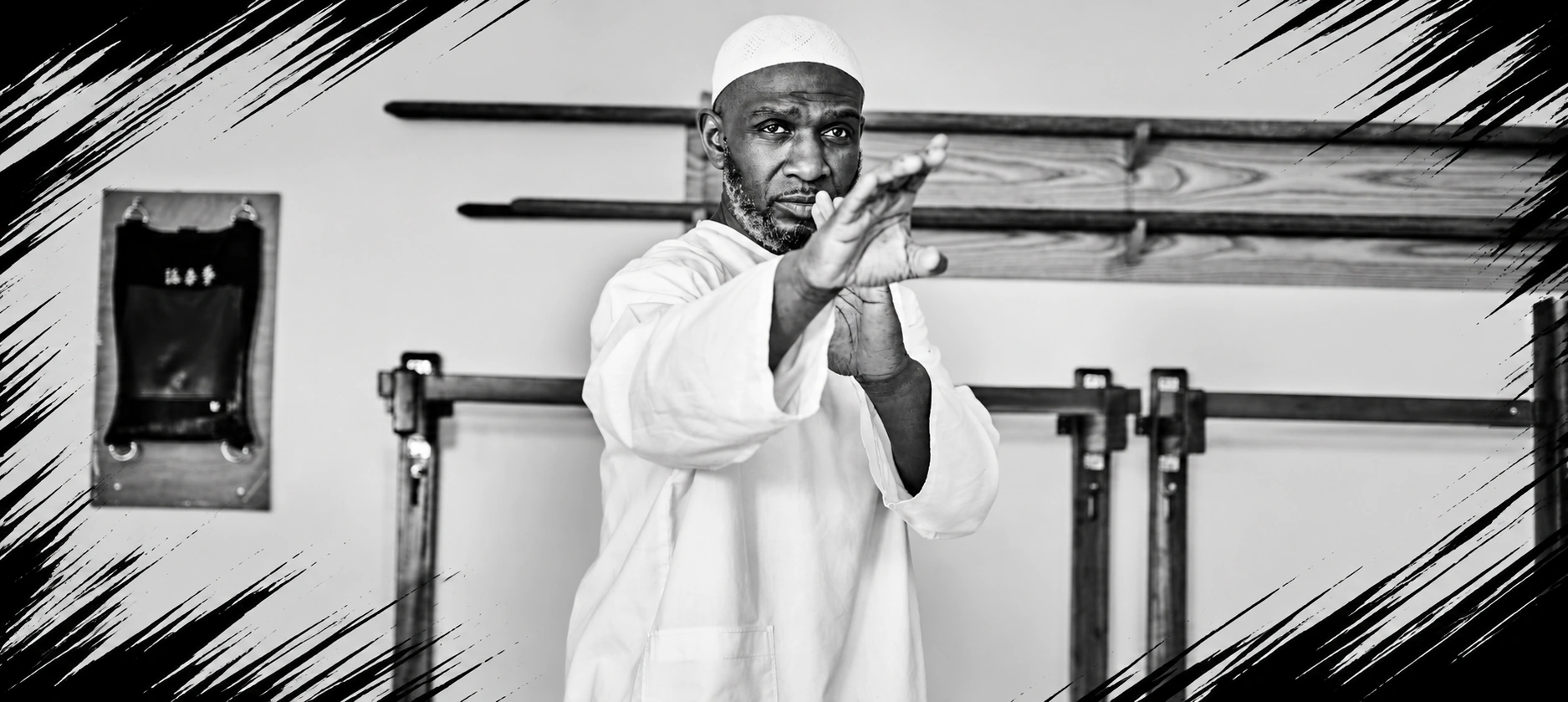
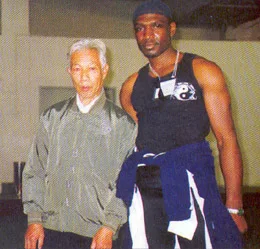
Sifu Garry McKenzie with Top Wing Chun master Leun Gai in Faat Saan.
Victor J.T Appiah interviews Sifu Garry McKenzie
Is Kung-Fu Difficult? - This is a question which I put to Wing Chun Kung Fu Sifu Garry McKenzie, who besides teaching Kung-Fu, speaks fluent Chinese ( Cantonese ), and is able to read and write in Chinese too. He visits Faat Saan ( Buddha Mountain ) in Southern China, the home of Wing Chun Kung-Fu, yearly where he trains and discusses martial arts issues with many famous Wing Chun masters.
I tracked Sifu McKenzie down to his club in Central London West End, and this is what he had to say, - learning Kung-Fu is not so difficult.
"It's just like going to school. It can be divided into three stages, each stage requiring three years or more of training. The first stage is basic works; the second stage is to consolidate it; the third is more advanced instruction and then refining it to perfection."
"The satisfactory completion of the first stage is said to be a minor attainment, the second a moderate, and the third a major attainment. As there is no clear distinction between the first and second stage, it is more commonly referred to as 'three year a minor attainment; ten years a major attainment.'"
"A minor attainment implies the establishing of a solid base, which is equivalent to junior high school. To have achieved a major attainment is like having gone through university and doing more advanced and specialised study and research. How much one achieves in their mastering of Kung-Fu depends on how much effort one puts in. Similarly, how one performs in school depends on how much time they spend on their homework. Having a good teacher or competent instructor is important, but personal effort is of paramount importance to the final result."
"Foundation-building in Kung-Fu is important as it is to a building project. A building's size and height is governed by it's foundation. We certainly could not attempt to erect a high-rise building on a foundation that was meant to support a small house. To relate this, in Kung-Fu if one only prepares for a minor attainment that is where they will stay. If major or better attainment is desired, one must fortify their foundation. In other words, the foundation must befit the project. With a solid foundation, one can plan and build to their own desire."
"Kung-Fu practitioners should from the beginning build a foundation that is meant for a major attainment, or at least moderate attainment. It was on this belief that Kung-Fu practitioners of the past paid undivided attention to foundation building. It was not unusual to see beginners being told to do so for up to three - five years before the first punch was thrown."
Grandmaster Ip Ching and Garry in Faat Saan, outside the ancestral hall.
"Just as a school has a curriculum to guide its smooth operation and overall teaching policy, in Kung-Fu a systematical and gradual process of instruction must be devised so that progressive teaching can be done. But unlike schooling in which a gifted student may skip a year or two, in Kung-Fu we cannot skip any part of it. There is only repeating and repeating if the result is unsatisfactory."
"Kung-Fu is closely connected with developing physical ability, it cannot be rushed through. This is what makes Kung-Fu a difficult art to master. During the first three years of basic works, one must be most consistent in the training regardless of weather and personal hardship, and there can be no respite."
"There are personal sacrifices and restraints, and there are also rules and etiquette to observe. In the past when the master and student relationship was much more formal, the sifu or instructor had the utmost authority, all rules and etiquette must be strictly obeyed or the student would not receive complete instruction."
"Serious offenders were often ejected out of the establishment, some were even punished in a cruel manner. The road to success in Kung-Fu was then, and is now, a rocky and bumpy one."
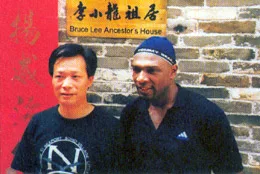
Garry with Sifu Ha Ji Sing outide Bruce Lee's ancestors house in Seun Dak, Southern China.
"Nothing is insurmountable, Kung-Fu is not an exception. A competetent and dedicated instructor plus personal determination and capacity to work is the formula of success. There is no overnight success; a day's work adds an edge to the total attainment, amonths work adds a bigger margin. Kung-Fu takes time to mellow and mature. It is not for the opportunist. It is neither easy nor difficult so long as practitioners do not stop at the thought of hard work, nor should they assume that there is an easy way to success."