
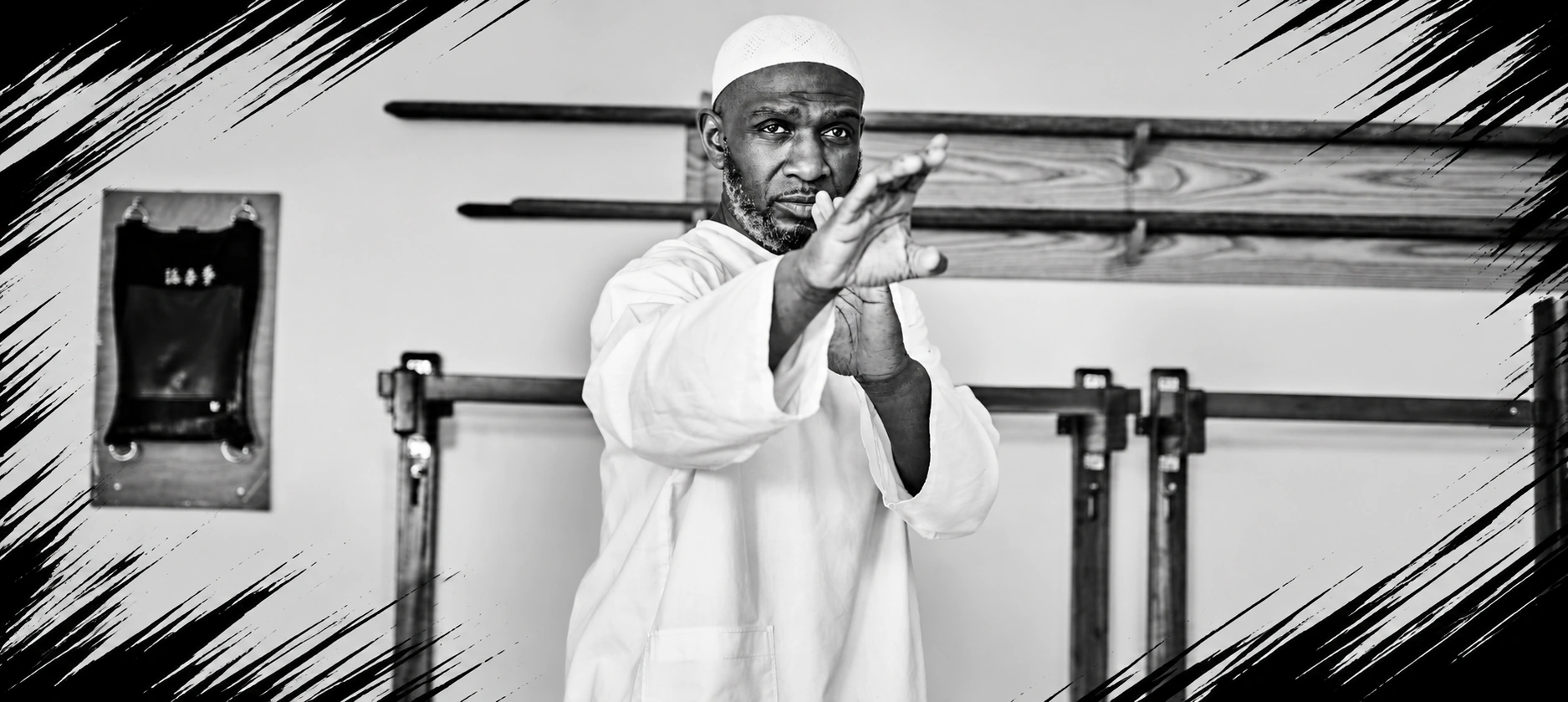
Combat: How did you first get involved in martial arts? And why?
G. McKenzie: I was only ten, had a rough upbringing and a violent temper, it needed controlling or it would get me hurt or in trouble. I saw David Carradine's 'Kung Fu' and then joined a judo school with my brother David for a year.
Combat: What did you do then?
G. McKenzie: At 12 I started learning Tae Kwon Do with Mr. Ohiu for 3 years. I appreciated the directness of kicking and punching as opposed to grappling and throwing. What frustrated me was the endless amounts of katas and my constant disqualification's in competitions for excessive force. This led me to learn western boxing at the Colvestone Gym in Hackney (London), training with Michael Watson, Kirkland Laing etc. It was the first time I ever got a full blow to the head - boy it hurt! Tae Kwon Do did not prepare me for these mobile loose, unconventional boxers, who were basically in my face.
Combat: How did you arrive at Wing Chun?
G. McKenzie: One day I got severely beaten and left for dead by a gang of racist thugs, which made me realize I had to master one thing and one thing only.
Combat: Why Wing Chun?
G. McKenzie: One day I was sparring with a Wing Chun practitioner. Without hardly any effort or movement he blocked whatever I threw at him - I couldn't actually get near him. Wing Chun seemed straightforward, simple, direct and very effective.
Combat: Who did you learn with?
G. McKenzie: I saw Simon Lau on 'Way of The Warrior' his Wing Chun was simply 'Explosive'. My brother David and I joined a twice weekly course with seventy other students.
Combat: How did you take to Wing Chun?
G. McKenzie: I trained hard and progressed well, which is why my Sifu decided to groom me for an instructor and teach me as his private student. David, due to pressures of work and family, dropped out for three years.
Combat: How long did you train under Simon Lau's personal guidance?
G. McKenzie: For 8 years. You see I had the key to his school - I would train there from 4.30pm - 7.30pm, then take the class until 10.00pm, then work on the door of this nightclub until 3.30am. Believe it or not I would then go back to the school for an hour to train on the dummy before bed. I was only 20, gave up my daytime job, had no wife or family then and plenty of time to train.
Combat: When did you break away and go independent?
G. McKenzie: After another 3 years of running a branch of the Simon Lau Martial Arts Academy' in Edmonton. I felt the need for independence for the sake of my personal development. No hard feelings it was just time to go, it's like a son leaving his home, his dad is still his dad. I then opened 'The Wing Chun School' in Hackney.
Combat: What did you teach?
G. McKenzie: Everything that my Sifu had taught me. My own style had been developing for some time, influenced by boxing. I suppose mobility, flexibility and footwork were incorporated to prevent surprises and be ready for anyone. The problem with many martial artists is that they can only fight similar stylists. This is unrealistic, the aggressor might not have any 'style' at all. Remember fight the man not the style.
Combat: How do you gear your students to 'fight the man'?
G. McKenzie: Firstly, they must have no preconceived ideas about what might happen in a fight - just act or react. Students come to me to learn to defend themselves so I must prepare them for everyone, Wing Chun allows for just this. As there are only 3 angles of attack, learning hundreds of different blocks is pointless. My students sum up the angle of attack and then counter attack as appropriate. Furthermore training in class is geared towards the way a student would fight in a real situation.
Combat: What training is of use for this?
G. McKenzie: I have developed a very fast paced drill called 'Pak Sau' sparring which allows for simultaneous attack, block, counterattack at close and long range. There are no fixed patterns - there never are in reality! It's up to the students to attack each other from whatever angle, with whatever combination and whatever part of the anatomy they see fit. The drill never stops, is very fast and heightens the students awareness, reaction, reflexes and speed.
Combat: How does your Wing Chun differ from other Wing Chun practitioners?
G. McKenzie: Method of training application and as I've said 'fighting the man'. Some students wrongly believe that their 'chi sao' will safeguard them against anyone. This is dangerous and stupid - chi sao is a sensitivity drill not real fighting. Also the attacker might not know how to 'chi sao'. Spar with a boxer and see if his jabs linger in the air for you.
Combat: What 'method of training'?
G. McKenzie: In my schools, fitness and stamina are essential and often neglected aspects of fighting. My students have physical and equipment workouts - every lesson. We use heavy bags, speed balls and hook and jab aids. At a higher level, the hook and jab pads allow for a full power sparring session using the whole Wing Chun arsenal (elbows, knees, fingers etc.) This can not be done in 'Pak Sau' drills as control is needed to prevent serious injury. The hook and jab drill brings out a student's imagination and individual personality.
Combat: Are there limitations to Wing Chun?
G. McKenzie: For me Wing Chun is a complete martial art, only people's minds are closed. For them if something is done slightly different, then it isn't Wing Chun. Don't forget that Wing Chun is an expression of concepts. The concept of 'pure' Wing Chun is nonsense - the art has to adapt and change with the times.
Combat: What of the politics in Wing Chun, the claims to 'authenticity'?
G. McKenzie: These terms - 'pure', 'authentic', and 'traditional' are simply self serving labels to promote business and lend credibility. Does anyone really know the meaning of these words? My Wing Chun is geared towards combat and has been tried and tested countless tines - on the streets and in clubs. The point to all this is simple - does it work?
Combat: What are you up to at present?
G. McKenzie: Training hard, a lot of teaching, opening up new branches and grooming my senior students. I've been meeting a lot of other Wing Chun Sifus and exchanging ideas - something I rarely used to do, as I believe you should be concerned about your own standard, not other people's. The problem is the amount of politics in Wing Chun generally - too much time wasted arguing about words! We are all Kung Fu brothers! Unity is what's needed, on that I'd just like to add that I will be holding a joint seminar later this year in London with America's legendary James DeMile! 'Wing Chun across the waters....' But I'm sure you'll get all the details soon.
Combat: Thank you.
G. McKenzie: My pleasure, thank you.